Engineering
Aeronautical Engineering Part 2: Aircraft Engineering and Modern Aviation Technologies #part2
Discover how modern aircraft are designed through aerodynamics, jet engines, avionics, flight control systems, composite materials, manufacturing, and flight testing.
Aeronautical Engineering: The Science Behind Aircraft Design, Flight, and Aviation
Part 2 — Aircraft Engineering and Modern Aviation Technologies
Introduction
Every time an airplane lifts off the runway, thousands of engineering decisions begin working together in perfect harmony.
The wings generate lift. The engines produce thrust. The flight control system continuously adjusts the aircraft's attitude. Lightweight composite materials withstand enormous aerodynamic forces. Hundreds of sensors monitor every critical system, while onboard computers help pilots navigate safely through changing weather and busy airspace.
To passengers, it may seem as simple as boarding a flight and arriving at their destination.
For aeronautical engineers, however, every successful flight is the result of years of research, testing, simulation, and innovation.
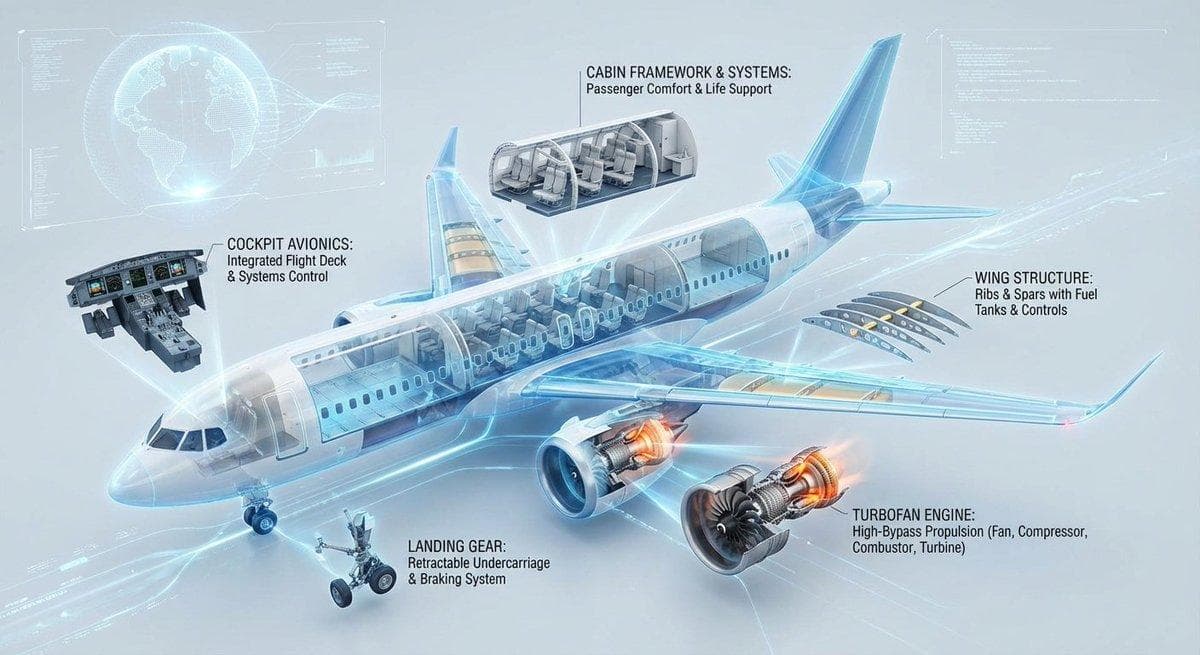
Part 1 introduced the foundations of aeronautical engineering and the basic principles of flight. In this chapter, we'll explore the engineering systems that transform those principles into real aircraft. From wing design and jet engines to avionics, composite materials, and wind tunnel testing, you'll discover how modern airplanes are designed to be faster, lighter, safer, and more efficient than ever before.
Figure 1. Modern aircraft are developed using advanced computer simulations, aerodynamic testing, and precision engineering before they ever leave the ground.
Caption: Aircraft design combines aerodynamics, structural engineering, propulsion, electronics, and extensive testing.
SEO Alt Text: Modern aeronautical engineering laboratory showing aircraft design, jet engine, and aerodynamic simulation.
Aircraft Structures: Building Aircraft That Are Strong and Light
One of the biggest challenges in aviation is balancing strength and weight.
An aircraft must be strong enough to withstand turbulence, pressure changes, hard landings, and millions of flight cycles. At the same time, every extra kilogram increases fuel consumption and operating costs.
Aeronautical engineers solve this challenge by designing highly optimized structures where every component has a specific purpose.
The primary structural components include:
- Fuselage
- Wings
- Empennage (tail section)
- Landing gear
- Engine mounts
- Internal frames and ribs
Modern airliners use computer simulations to determine where material is truly needed. Areas experiencing lower stress can be made thinner, while high-stress regions receive additional reinforcement.
This approach allows aircraft to remain both lightweight and incredibly durable.
Aerodynamics: Shaping the Air Around an Aircraft
If aircraft structures provide strength, aerodynamics provides efficiency.
Aerodynamics is the study of how air flows around moving objects.
When engineers design a wing, they aren't simply creating an attractive shape. Every curve influences airflow.
Poor aerodynamic design creates:
- Higher drag
- Increased fuel consumption
- Reduced range
- Lower stability
- More noise
Good aerodynamic design allows aircraft to:
- Fly farther
- Consume less fuel
- Generate greater lift
- Improve passenger comfort
- Reduce environmental impact
Computational Fluid Dynamics (CFD) software enables engineers to simulate airflow around aircraft long before physical prototypes are built.
Figure 2. Engineers use computational fluid dynamics (CFD) and wind tunnel testing to visualize airflow and optimize aircraft performance.
Caption: Understanding airflow is essential for reducing drag and increasing lift.
SEO Alt Text: Airflow simulation over an aircraft wing using computational fluid dynamics.
Aircraft Propulsion: Producing the Thrust to Fly
An airplane cannot remain airborne without forward motion.
That forward force is called thrust, and it is produced by the aircraft's propulsion system.
Different aircraft use different propulsion technologies:
| Aircraft Type | Propulsion System |
|---|---|
| Commercial Airliner | Turbofan Engine |
| Fighter Jet | Afterburning Turbofan |
| Small Aircraft | Piston Engine |
| Cargo Aircraft | Turboprop |
| Helicopter | Turboshaft Engine |
| Drone | Electric Motor |
The most common propulsion system in modern aviation is the turbofan engine.
Inside a turbofan engine, air enters through the intake, is compressed, mixed with fuel, ignited in the combustion chamber, and expelled through the exhaust nozzle at extremely high speed.
According to Newton's Third Law of Motion, the backward flow of exhaust gases produces the forward thrust that propels the aircraft.
Jet Engines: Engineering at Extreme Temperatures
Modern jet engines are among the most advanced machines ever built.
Their turbine blades rotate at thousands of revolutions per minute while operating in temperatures exceeding 1,500°C (2,732°F)—hotter than the melting point of many metals.
To survive these conditions, engineers use:
- Nickel-based superalloys
- Ceramic thermal coatings
- Internal cooling channels
- Precision manufacturing techniques
Today's engines are designed not only for power but also for fuel efficiency, reliability, and reduced emissions.
Avionics: The Digital Brain of an Aircraft
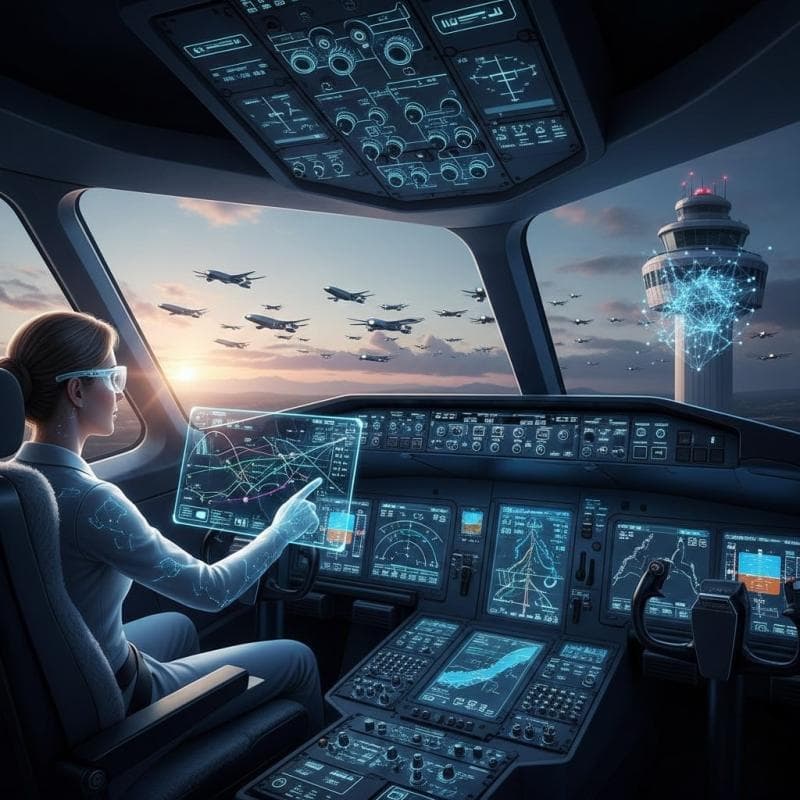
Modern aircraft rely on sophisticated electronic systems known collectively as avionics.
These systems help pilots monitor, navigate, communicate, and control the aircraft.
Key avionics components include:
- Flight Management Computer (FMC)
- GPS Navigation
- Weather Radar
- Traffic Collision Avoidance System (TCAS)
- Autopilot
- Glass Cockpit Displays
- Communication Radios
- Digital Flight Instruments
Modern airliners process enormous amounts of data every second, helping pilots make informed decisions while improving overall flight safety.
Flight Control Systems
Pilots don't directly move an aircraft by pushing on the wings or tail.
Instead, they manipulate control surfaces that alter airflow.
The primary control surfaces are:
- Ailerons
- Elevators
- Rudder
- Flaps
- Slats
- Spoilers
Together, these components control:
- Roll
- Pitch
- Yaw
Many modern aircraft use fly-by-wire systems, where pilot inputs are transmitted electronically to onboard computers, which then command actuators to move the control surfaces with remarkable precision.
This technology improves handling, safety, and fuel efficiency.
Figure 3. Flight control surfaces allow pilots and onboard computers to control an aircraft's movement in three dimensions.
Caption: Ailerons, elevators, and the rudder work together to control roll, pitch, and yaw.
SEO Alt Text: Diagram of aircraft flight control surfaces including ailerons, elevators, rudder, flaps, and spoilers.
Aircraft Materials: Lighter, Stronger, and More Efficient
Early airplanes were constructed from wood and fabric.
Modern aircraft use advanced materials engineered for strength, durability, and reduced weight.
Common materials include:
| Material | Application |
|---|---|
| Aluminum Alloys | Wings, fuselage |
| Titanium | Engine components |
| Carbon Fiber Composites | Wings, fuselage panels |
| Fiberglass | Interior panels |
| Nickel Superalloys | Turbine blades |
Carbon fiber composites have become especially important because they provide exceptional strength while weighing significantly less than traditional metals.
This directly improves fuel efficiency and reduces carbon emissions.
Aircraft Manufacturing
Designing an aircraft is only the beginning.
Manufacturing requires extraordinary precision.
Large passenger aircraft contain millions of individual parts supplied by companies around the world.
During assembly:
- Structural sections are joined.
- Engines are installed.
- Wiring systems are connected.
- Hydraulic systems are tested.
- Avionics are integrated.
- Safety inspections are performed.
Every completed aircraft undergoes extensive ground testing before its first flight.
Flight Testing
Before passengers ever board a new aircraft, engineers perform months—or even years—of flight testing.
These tests evaluate:
- Stall characteristics
- Engine performance
- Fuel efficiency
- Emergency procedures
- High-speed flight
- Landing performance
- Structural integrity
- Control system behavior
Highly trained test pilots work closely with engineers to collect detailed performance data under carefully controlled conditions.
Only after successfully completing rigorous certification requirements can a new aircraft enter commercial service.
Engineering Insight
A commercial aircraft is not considered safe because it usually works. It is considered safe because engineers have demonstrated—through design, simulation, laboratory testing, and thousands of hours of flight testing—that it performs reliably across an enormous range of operating conditions.
Maintenance Engineering: Keeping Aircraft Airworthy
Aircraft engineering doesn't end after delivery.
Routine maintenance is essential throughout an aircraft's operational life.
Maintenance engineers inspect:
- Engines
- Wings
- Landing gear
- Hydraulic systems
- Electrical wiring
- Flight control surfaces
- Avionics
- Structural components
Regular inspections help identify wear or damage long before they become safety concerns.
This proactive approach is one of the reasons modern commercial aviation remains among the safest forms of transportation.
Key Takeaways
- Aircraft structures are designed to maximize strength while minimizing weight.
- Aerodynamics improves efficiency by optimizing airflow and reducing drag.
- Jet engines generate thrust using high-speed exhaust gases.
- Avionics provide navigation, communication, and flight management capabilities.
- Fly-by-wire systems enhance aircraft stability and control.
- Composite materials have transformed modern aircraft design.
- Every aircraft undergoes rigorous manufacturing and flight testing before entering service.
- Continuous maintenance ensures long-term safety and reliability.
Write your article here...
About the Author
Aslam Hossain is the founder and editor of Vishtech Blog, creating accessible technology content about AI, software, startups, robotics, cybersecurity, and future innovations.
Comments
Article text preview: Aeronautical Engineering: The Science Behind Aircraft Design, Flight, and Aviation Part 2 — Aircraft Engineering and Modern Aviation Technologies Intr