Future Tech
How Black Holes Form: From Dying Stars to Cosmic Giants
Discover how black holes form, from the collapse of massive stars to the mysterious origins of supermassive black holes in the early universe.
How Black Holes Form: The Birth of the Universe’s Most Mysterious Objects
Black holes are among the strangest objects in the universe.
They are not stars. They are not planets. And despite their name, they are not really holes in the ordinary sense.
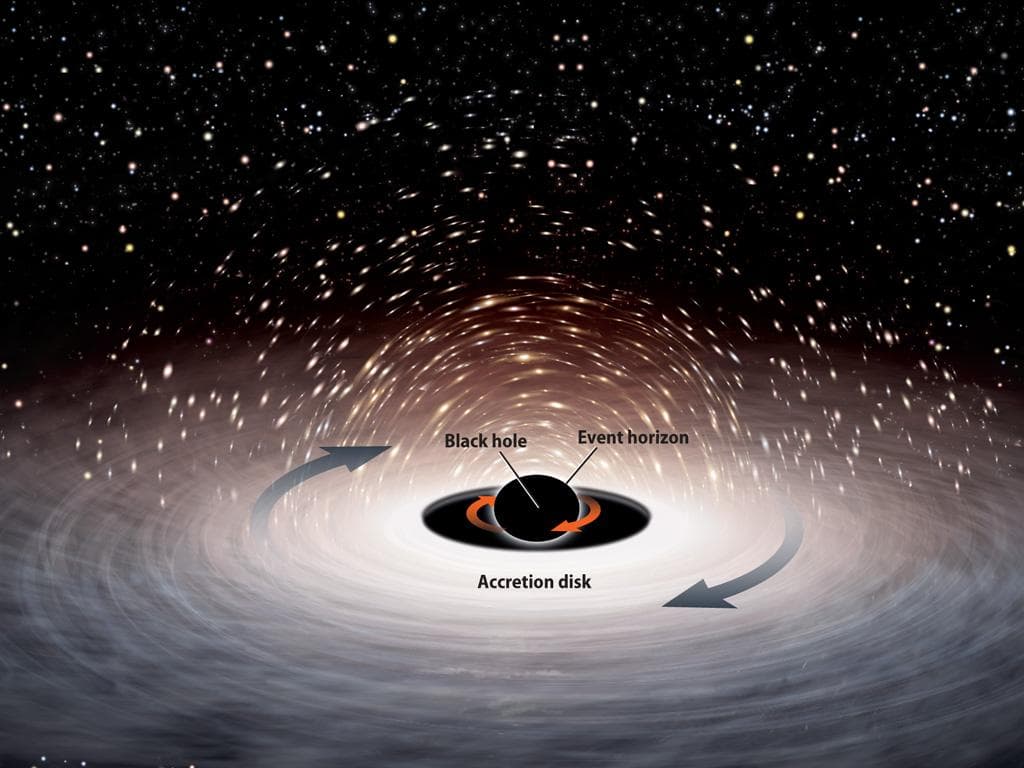
A black hole is a region of spacetime where gravity becomes so intense that, once something crosses a boundary called the event horizon, it cannot escape—not even light. Yet the most interesting part of the story is not simply what a black hole is.
It is how one comes into existence.
For some black holes, the answer begins with the death of a massive star. A star that once spent millions of years producing energy through nuclear fusion can eventually reach a point where its internal support fails. Gravity takes over, the core collapses, and under the right conditions, a black hole is born.
But that explanation becomes much more complicated when we look at the enormous black holes sitting at the centers of galaxies.
Some of these objects contain millions or even billions of times the mass of the Sun. Even more puzzling, astronomers have found enormous black holes in the very early universe—at a time when there seemingly was not enough time for small black holes to grow into such giants.
So the story of black-hole formation is actually several stories.
There is the relatively well-understood story of stellar-mass black holes.
There is the mysterious story of supermassive black holes.
And there may be an even older story involving black holes that could have formed during the earliest moments of the universe.
Let's start with the most familiar pathway.
A Black Hole Begins With Gravity
Everything about a black hole comes back to gravity.
Stars are enormous collections of gas held together by their own gravitational attraction. Gravity is always trying to pull that material toward the center.
But during most of a star's life, another process pushes back.
Deep inside the star, enormous pressure and temperature allow nuclear fusion to take place. Hydrogen nuclei combine to produce helium, releasing energy in the process. That energy helps create outward pressure that balances the inward pull of gravity.
This balance is one of the fundamental reasons stars can remain stable for millions or billions of years.
The star is essentially caught in a continuous battle:
Gravity pulls inward.
Pressure pushes outward.
As long as the balance survives, the star can continue shining.
But stars do not have an unlimited supply of nuclear fuel.
Eventually, the balance begins to change.
The Life of a Massive Star
Not all stars live the same way.
A relatively small star such as the Sun follows a very different evolutionary path from a star many times more massive than the Sun.
Massive stars burn through their nuclear fuel at an extraordinary rate.
They are brighter and hotter, but their enormous energy output comes with a cost: they consume their fuel much faster.
Over time, fusion inside the core can create progressively heavier elements.
Hydrogen becomes helium.
Helium can be transformed into heavier elements.
Eventually, massive stars can build up layers containing elements such as carbon, oxygen, silicon and eventually iron.
And iron creates a serious problem.
The nuclear reactions involving iron do not provide the same kind of energy support that earlier fusion stages do.
The star is approaching the end.
When the Star Can No Longer Fight Gravity
Eventually, the star's core can no longer produce enough energy to maintain the pressure needed to oppose gravity.
The balance begins to fail.
Gravity suddenly becomes the dominant force.
The core begins collapsing inward.
This is not a slow process on astronomical timescales. Once the collapse begins, the central region can contract extremely rapidly.
The outer layers of the star may be violently expelled into space in a supernova.
What remains at the center becomes enormously dense.
And this is where the future of the star is decided.
If the remaining core is not too massive, it may become a neutron star.
If the core is sufficiently massive, however, gravity can continue the collapse until a black hole forms.
ESA describes this basic pathway as the collapse of the core of a sufficiently massive star after it has developed an iron core, with the remaining compact core collapsing further when its mass is high enough.
NASA/ESA observations and illustrations of the massive star N6946-BH1 provide a striking example of a massive star that disappeared after apparently undergoing collapse rather than producing the expected bright supernova. NASA reports that the star was about 25 times the Sun's mass.
This is one of the most fascinating pieces of evidence because astronomers were able to observe a massive star before it disappeared and then investigate what happened afterward.
The Death of a Star Can Become the Birth of a Black Hole
Imagine a star much more massive than the Sun.
For millions of years, it has been producing energy.
Its interior is incredibly hot.
Its gravity is enormous.
Eventually, its nuclear fuel can no longer provide the support required to hold the star up.
The core collapses.
If enough mass remains in that core, there is no known force capable of stopping the collapse.
The material becomes increasingly compressed.
The gravitational field becomes increasingly intense.
Eventually, an event horizon forms.
At that moment, the star has effectively produced a black hole.
NASA explains that a stellar-mass black hole can form when a massive star exhausts its nuclear fuel and its core collapses; if the remaining core is more than roughly three times the Sun's mass, current known forces cannot halt the collapse.
The black hole may contain only a fraction of the original star's mass.
Much of the star can be expelled into space.
But the collapsed core remains.
And that compact remnant becomes one of the most extreme objects known to physics.
What Actually Makes It a Black Hole?
It is tempting to imagine that a black hole is simply a very dense ball of matter.
That is not quite right.
The defining feature is the formation of an event horizon.
The event horizon is a boundary around the black hole.
Outside that boundary, escape is still possible in principle.
Inside it, all possible paths lead inward.
Light cannot escape.
This is why black holes appear dark.
But there is an important distinction:
The black hole itself is not necessarily what we see.
Astronomers often detect black holes because of their effects on the surrounding environment.
A nearby star may orbit an apparently invisible object.
Gas may spiral toward it.
Matter can become extremely hot before crossing the event horizon.
The black hole can also dramatically bend light passing nearby.
That combination of invisible gravity and visible effects gives astronomers a way to find objects that cannot be observed directly.
The Accretion Disk: Where a Black Hole Becomes Visible
One of the most recognizable features associated with black holes is the glowing ring of material surrounding them.
This is called an accretion disk.
It forms when gas, dust or other material falls toward a black hole but carries angular momentum. Instead of dropping straight inward, the material spirals around the black hole.
As the material moves through the disk, friction and other physical processes convert gravitational energy into heat.
The gas can become incredibly hot.
The result can be intense radiation.
In some systems, the radiation is powerful enough for telescopes to detect the black hole's presence from enormous distances.
This is why a black hole can be invisible while its surroundings are extraordinarily bright.
The glowing material around a black hole is not the black hole itself. It is hot matter interacting with the extreme gravitational environment around it. NASA's black-hole visualizations illustrate how the accretion disk and strongly curved light create the appearance associated with these objects.
The distinction is important because many popular images of black holes show a glowing disk and a dark center. The glowing material is outside the event horizon.
A Black Hole Is Not a Cosmic Vacuum Cleaner
Black holes are often described as cosmic vacuum cleaners.
That description is misleading.
A black hole does not automatically suck everything nearby into itself.
If the Sun were somehow replaced by a black hole with exactly the same mass, Earth would not suddenly be pulled into it. The gravitational influence at Earth's orbit would be essentially the same.
The problem would be the disappearance of sunlight, not an instant gravitational collapse.
What makes black holes dangerous is what happens when objects get sufficiently close.
Near the black hole, gravity becomes extremely strong.
Matter can be torn apart.
Light can be bent dramatically.
Time and space behave in ways that seem completely foreign to everyday experience.
The closer an object gets, the more extreme the environment becomes.
What Happens to the Star's Core?
The exact physics at the deepest center of a black hole is one of the biggest unanswered questions in modern physics.
General relativity predicts that the collapsing material can continue toward a singularity—a region where the mathematical description of spacetime becomes extreme.
But physicists do not yet have a complete theory combining general relativity with quantum mechanics.
That means we do not have a complete physical description of what ultimately happens at the deepest interior.
This is one reason black holes are so important scientifically.
They are not simply astronomical objects.
They are places where our existing theories are pushed to their limits.
Not Every Massive Star Becomes a Black Hole
It would be incorrect to say that every massive star eventually becomes a black hole.
The final outcome depends on several factors.
The star's original mass matters.
Its chemical composition matters.
Mass loss through stellar winds can matter.
The structure and mass of the remaining core are particularly important.
Some massive stars leave behind neutron stars.
Others can leave black holes.
There are also cases in which a star may collapse in a way that does not produce a conventional bright supernova.
One particularly interesting example is N6946-BH1.
Astronomers expected a massive star in the galaxy NGC 6946 to undergo a spectacular explosion. Instead, the star disappeared from view, leading researchers to propose that it may have collapsed directly into a black hole. NASA's Jet Propulsion Laboratory described it as a possible case of a massive dying star "reborn" as a black hole.
That observation gives scientists an important reminder:
A black hole can sometimes be born quietly.
The Black Holes We Find in the Milky Way
Our galaxy is not empty of black holes.
Astronomers have identified stellar-mass black holes in the Milky Way by observing their effects on companion stars and surrounding matter.
One particularly interesting discovery came from the European Southern Observatory in 2024.
Astronomers identified a black hole called Gaia BH3, with a mass of about 33 times that of the Sun.
It is around 2,000 light-years from Earth and was identified through the unusual motion of a companion star orbiting it. ESO described it as the most massive stellar black hole known in the Milky Way at the time of the announcement.
The discovery is significant because black holes are difficult to find when they are not actively consuming matter.
Sometimes the best evidence is simply a star behaving strangely.
Artist's impressions and observational material from ESO help illustrate how astronomers can identify an invisible black hole by tracking the motion of a companion star.
But Stellar Black Holes Are Only the Beginning
Stellar-mass black holes are fascinating.
But they are not the largest black holes in the universe.
At the centers of galaxies are objects on an entirely different scale.
These are supermassive black holes.
They can contain millions, hundreds of millions or even billions of times the mass of the Sun.
The Milky Way itself contains a supermassive black hole at its center.
It is called Sagittarius A*.
Its mass is roughly four million times that of the Sun.
The question is obvious:
How did something that massive form?
And this is where the story becomes much less certain.
The Mystery of Supermassive Black Holes
For a long time, one simple idea seemed reasonable.
Perhaps supermassive black holes started as ordinary stellar-mass black holes.
Then they slowly consumed gas.
They merged with other black holes.
Over millions and billions of years, they grew.
There is certainly evidence that black holes can grow this way.
NASA notes that black holes can gain mass by accreting matter, including gas from nearby stars, and through mergers with other black holes.
But there is a problem.
The universe contains supermassive black holes that existed surprisingly early in cosmic history.
Some were already enormous when the universe was less than a billion years old.
That raises an uncomfortable question:
How could they have grown so quickly?
The Early Universe Changes the Story
The early universe was very different from the cosmos we see today.
There were no mature galaxies like the Milky Way.
The first generations of stars were forming.
Gas was gathering into enormous structures.
Dark matter was creating gravitational scaffolding around which galaxies could develop.
And somewhere inside this rapidly evolving environment, the first black-hole seeds may have appeared.
Astronomers have discovered evidence of massive black holes at surprisingly early cosmic times, making their origin one of the major unresolved questions in astrophysics. ESA notes that some early supermassive black holes appear too massive to have simply grown from small stellar remnants under ordinary assumptions.
That means scientists have begun considering formation mechanisms that are more extreme than the death of an ordinary star.
The Direct-Collapse Idea
One possibility is called direct collapse.
Instead of first forming ordinary stars, an enormous cloud of gas could collapse under its own gravity and produce a massive black-hole seed.
In this scenario, the universe would skip an important step.
Normally:
Gas → Star → Stellar black hole
But under special early-universe conditions, the pathway might look more like:
Huge gas cloud → Massive object → Black-hole seed
NASA-supported research has investigated scenarios in which rapidly growing early galaxies could create conditions allowing massive black-hole seeds to form without going through the ordinary life cycle of a star.
NASA simulations have explored how rapidly assembling structures in the early universe could create massive black-hole seeds. One NASA visualization shows a region of young galaxies and massive stars that can rapidly collapse into black holes.
This idea is attractive because a larger starting seed requires less time to grow into a supermassive black hole.
The First Stars May Have Been Different
Another possibility involves the first generation of stars.
These ancient stars—often called Population III stars—were fundamentally different from most stars we see today.
The early universe contained mostly hydrogen and helium, with very little of the heavier elements that were produced later inside stars.
Because these first stars formed from relatively pristine material, some models suggest they could have become extremely massive.
If some of these enormous stars collapsed, they could have produced black holes substantially more massive than many stellar black holes forming today.
Those black holes could then act as seeds.
Over time, they could consume gas and merge with other black holes.
Eventually, some might grow into supermassive objects.
ESA/Hubble research has also found evidence supporting the possibility that some early black holes originated from the collapse of massive, pristine stars during the universe's first billion years.
Could Black Holes Have Formed Before the First Stars?
There is an even more radical possibility.
What if some black holes did not come from stars at all?
What if they formed directly from extremely dense regions of the early universe?
These hypothetical objects are called primordial black holes.
The idea is that shortly after the Big Bang, the density of matter was extremely high.
If certain regions were sufficiently dense, they could potentially collapse under their own gravity.
No star would be necessary.
No supernova would be necessary.
The black hole would essentially be a product of the early universe itself.
This possibility has been investigated as a potential explanation for both some dark-matter questions and the origin of massive black-hole seeds, although primordial black holes remain hypothetical. ESA has highlighted models in which black holes could have formed very early in cosmic history and subsequently merged into larger objects.
The Black Hole That May Have Formed Before Its Galaxy
Recent observations have made this mystery even more interesting.
In 2026, observations from the NASA/ESA/CSA James Webb Space Telescope of the distant system Abell 2744-QSO1 provided evidence suggesting that a roughly 50-million-solar-mass black hole may have existed before the surrounding galaxy fully developed.
The object lies more than 13 billion light-years away.
According to ESA/Webb, the observations suggest that the black hole may have formed extremely early and may have been unusually massive from the beginning.
This does not mean scientists have solved the mystery.
Quite the opposite.
It makes the mystery more interesting.
If some black holes really did become massive before their host galaxies, then the traditional picture—galaxy first, black hole second—may be incomplete.
JWST observations of the early-universe system Abell 2744-QSO1 are helping astronomers investigate whether some massive black holes formed before their surrounding galaxies.
Do Black Holes Grow After They Form?
Absolutely.
Formation is only the beginning.
Once a black hole exists, it can become larger.
One route is accretion.
Gas and dust can fall toward the black hole.
A companion star can lose material.
Entire clouds of gas can be drawn inward.
The material forms a disk, heats up and gradually loses energy.
Some of it eventually crosses the event horizon.
The black hole gains mass.
Another route is even more dramatic.
Black holes can merge.
When Two Black Holes Become One
Imagine two black holes orbiting one another.
They are both moving through curved spacetime.
As they orbit, the system can lose energy through gravitational waves.
The orbit gradually shrinks.
The black holes move closer.
Faster.
Closer.
Faster still.
Eventually, they merge.
The final event is extraordinarily violent in terms of gravitational energy.
The resulting black hole rings down and settles into a new state.
The event sends gravitational waves across the universe.
In 2015, the LIGO collaboration detected gravitational waves from merging black holes for the first time, opening an entirely new way of observing the cosmos.
This changed astronomy.
Before gravitational-wave astronomy, scientists mostly observed the universe through electromagnetic radiation such as visible light, radio waves and X-rays.
Now they can also detect the movement of spacetime itself.
Black Holes Can Become Cosmic Giants
The growth process can continue.
A relatively small black-hole seed can consume gas.
It can merge with another black hole.
The resulting black hole can consume more material.
More mergers can follow.
Over enormous periods of time, these processes can produce objects millions or billions of times more massive than the Sun.
This is likely part of the story behind the supermassive black holes found in galaxy centers.
But scientists still do not know whether this is the entire story.
The earliest supermassive black holes appear to challenge the idea that they all started as small stellar remnants.
That is why astronomers are searching for intermediate-mass black holes and massive early black-hole seeds.
They may provide the missing link.
The Missing Middle
Black holes are often described as belonging to two major categories:
Stellar-mass black holes
and
Supermassive black holes.
But there is a middle range.
These are called intermediate-mass black holes, or IMBHs.
They are more massive than ordinary stellar black holes but considerably smaller than the supermassive giants at galaxy centers.
For years, astronomers have searched for convincing examples.
Why are they important?
Because they could represent an evolutionary bridge.
A possible pathway might look like this:
Massive star → stellar black hole → intermediate-mass black hole → supermassive black hole
If enough intermediate-mass black holes exist and can be shown to grow efficiently, they could help explain how the universe produced its largest black holes.
ESA identifies intermediate-mass black holes as an important missing piece in our understanding of black-hole evolution.
What We Still Don't Know
Despite decades of research, some of the biggest questions remain unanswered.
We do not know exactly how the first black-hole seeds formed.
We do not know how some black holes became billions of solar masses so quickly.
We do not know whether primordial black holes exist.
We do not know exactly what happens to matter at the deepest interior of a black hole.
And we do not completely understand how black holes and galaxies influenced each other's growth during cosmic history.
These are not minor details.
They could change our understanding of how the universe developed.
Black Holes and Galaxies May Have Grown Together
One of the most interesting discoveries in modern astronomy is the relationship between galaxies and their central black holes.
The black hole can affect its surroundings.
When enormous amounts of gas fall toward a supermassive black hole, the resulting accretion process can release huge quantities of energy.
Some active black holes produce powerful jets extending thousands or even millions of light-years.
These energetic outflows can interact with surrounding gas.
In some circumstances, that activity can influence whether new stars form.
This means a black hole is not necessarily just a passive object sitting at the center of a galaxy.
It can influence the evolution of the galaxy around it.
ESA/Hubble notes that observations of black holes and their surrounding environments have helped establish their important relationship with galaxy formation and evolution.
The Strange Case of Quasars
Sometimes a supermassive black hole becomes extraordinarily active.
Huge quantities of gas fall toward it.
The accretion disk becomes intensely luminous.
The result can be a quasar.
A quasar can shine so brightly that it becomes visible across billions of light-years.
This creates one of astronomy's great paradoxes.
The central object is a black hole, which emits no light from within its event horizon.
Yet the environment immediately outside it can become one of the brightest sources in the universe.
The darkness creates the light.
Not literally, but gravitational energy released by matter falling toward the black hole can power extraordinary radiation.
How Astronomers Know Black Holes Exist
We cannot simply point a normal telescope at a black hole and see it.
Instead, scientists look for evidence.
One method is to observe stars orbiting an invisible object.
Another is to detect X-rays from hot material around a black hole.
Another is to measure gravitational waves produced when black holes merge.
Another is to observe how light bends around a black hole.
And in some cases, radio telescopes can produce an image of the black hole's surrounding environment.
The first image of a black hole's shadow was released in 2019 by the Event Horizon Telescope collaboration.
It showed the environment surrounding the supermassive black hole at the center of the galaxy Messier 87.
NASA describes the result as a dark central region silhouetted against hot, glowing material orbiting around it.
The famous M87 black-hole image is not a conventional photograph of the black hole's interior. It shows the dark central shadow against glowing material surrounding the black hole.
So, How Does a Black Hole Form?
After following the story from the life of a star to the evolution of galaxies, we can finally answer the original question.
A black hole forms when matter becomes compressed enough that gravity creates an event horizon.
For a typical stellar-mass black hole, this happens after a sufficiently massive star exhausts its nuclear fuel and its core collapses.
For larger black holes, the story can involve:
- Accretion of enormous quantities of gas
- Mergers between smaller black holes
- Massive early stars
- Direct collapse of enormous gas clouds
- Possibly primordial black holes
- Other mechanisms that scientists are still investigating
The formation pathway therefore depends on the type of black hole.
There is no single recipe.
The Universe May Have More Than One Way to Make a Black Hole
That may be the most important lesson.
When we look at a black hole today, we are seeing the final result of a process that may have begun billions of years ago.
A stellar black hole may carry the remains of a massive star.
A supermassive black hole may preserve evidence of the earliest stages of galaxy formation.
A hypothetical primordial black hole could potentially carry information from an era even older than the first stars.
In that sense, black holes are more than objects of extreme gravity.
They are cosmic archives.
Their masses, environments, mergers and locations can tell us about the history of matter itself.
The Next Generation of Telescopes May Change the Story
Astronomy is entering an extraordinary period.
The James Webb Space Telescope is observing some of the earliest galaxies and black-hole systems ever studied.
The Hubble Space Telescope continues to investigate black holes and their host galaxies.
The European Southern Observatory's extremely sensitive ground-based instruments can track stars and black-hole environments in remarkable detail.
Gravitational-wave observatories are detecting mergers that cannot be studied using ordinary light.
And future missions such as ESA's LISA are designed to investigate gravitational waves from massive black-hole systems across cosmic history.
Each new observation can test the theories scientists currently use to explain black-hole formation.
Some theories will survive.
Others will need to change.
That is how science moves forward.
A Black Hole Is the Beginning of a Story, Not the End
It is easy to think of a black hole as the final stage of a star.
In one sense, it is.
A massive star can spend millions of years shining brilliantly before its core collapses into an object that emits no ordinary light.
But from a cosmic perspective, the formation of the black hole may actually be the beginning of something much larger.
The new black hole can capture matter.
It can interact with stars.
It can merge with other black holes.
It can grow.
Eventually, black holes can become central engines of galaxies.
Some can power quasars.
Some can influence the formation of stars.
Some can collide and send gravitational waves across the universe.
And some may have existed so early that they challenge our understanding of how the first galaxies themselves were assembled.
That is why the question "How do black holes form?" is much bigger than it first appears.
It is really a question about how stars die, how galaxies grow, how gravity shapes the universe—and perhaps how the universe's earliest structures came into existence.
Key Takeaways
- Stellar-mass black holes commonly form from the gravitational collapse of sufficiently massive stellar cores.
- A massive star can exhaust its nuclear fuel, causing its core to collapse.
- Some stellar collapses produce neutron stars instead; sufficiently massive remnants can form black holes.
- The event horizon is the boundary beyond which light cannot escape.
- Black holes themselves are dark, but their surrounding accretion disks can become extremely bright.
- Black holes can grow by consuming gas and other matter.
- Two black holes can merge, producing a larger black hole and gravitational waves.
- Supermassive black holes contain millions to billions of solar masses and are found at the centers of large galaxies.
- Their origins remain one of the biggest problems in modern astrophysics.
- Possible explanations include massive early stars, direct collapse of gas clouds, mergers and potentially primordial black holes.
- Recent JWST observations are providing new evidence about the possibility that some massive black holes formed extremely early—possibly before their surrounding galaxies.
- Future observatories may reveal how the first black holes became the enormous objects we see today.
Frequently Asked Questions
Can the Sun become a black hole?
No. The Sun does not have enough mass to undergo the type of core collapse required to form a stellar-mass black hole. It is expected to end its life as a white dwarf.
Does every massive star create a black hole?
No. Some massive stars leave behind neutron stars, while others can produce black holes. The final outcome depends strongly on the properties of the collapsing core.
How quickly does a black hole form?
Once a sufficiently massive stellar core becomes unstable, the actual collapse happens extremely rapidly compared with the star's millions-of-years lifetime. The detailed outcome depends on the physics of the collapse.
Can black holes grow?
Yes. They can gain mass through accretion and through mergers with other black holes.
How do supermassive black holes become so large?
Scientists do not yet have a complete answer. They may begin as unusually massive seeds and then grow through accretion and mergers. Direct-collapse scenarios and other early-universe mechanisms are also being studied.
Did black holes exist before stars?
Possibly, but it has not been established. Primordial black holes are a theoretical possibility that could have formed in the early universe without requiring stars.
What is the biggest black hole?
Astronomers have identified extremely massive black holes with masses of billions of Suns, but the exact record-holder can change as new measurements are made. More importantly, scientists are still trying to understand how such enormous objects formed in the first place.
Conclusion
A black hole can begin with the death of a star.
A massive star spends its life using nuclear fusion to resist gravity. When its fuel runs out, that balance can collapse. The core falls inward, the star may explode or collapse directly, and if enough mass remains, an event horizon forms.
But that is only the simplest chapter.
The universe also contains supermassive black holes that are millions or billions of times more massive than the Sun. Some appeared surprisingly early in cosmic history, forcing astronomers to rethink how quickly black holes could grow and whether some were born with enormous masses from the beginning.
Perhaps the first black holes came from massive stars.
Perhaps enormous clouds of primordial gas collapsed directly.
Perhaps some black holes were created during the earliest moments of the universe.
Or perhaps the real answer involves several of these mechanisms working together.
For now, scientists do not have the complete story.
And that uncertainty is exactly what makes black holes so valuable.
Every new black hole discovered is another opportunity to understand gravity, stars, galaxies and the history of the universe itself.
The darkest objects in the cosmos may therefore be among our brightest clues about where everything came from.The Moment Gravity Takes Over
Once the core loses its ability to support itself, gravity begins pulling it inward at extraordinary speed.
The core collapses.
The outer layers of the star can be violently expelled, while the central core becomes an incredibly compact object.
NASA/ESA illustration showing the final stages of a massive star collapsing toward black-hole formation.
This visual fits here because the reader can immediately see the transition from a massive dying star to the formation of a black hole.
What Does a Black Hole Look Like?
The black hole itself cannot be seen directly. What astronomers observe is often the hot material surrounding it.
Gas can form an accretion disk around the black hole. As that material moves inward, it becomes extremely hot and can produce powerful radiation.
NASA visualization and Event Horizon Telescope imagery showing the appearance and environment of a black hole.
Black Holes Can Grow
A black hole does not necessarily remain the same size after it forms.
It can gain mass by consuming surrounding matter and by merging with other black holes.
Artist's visualization of two black holes orbiting and eventually merging.
About the Author
Aslam Hossain is the founder and editor of Vishtech Blog, creating accessible technology content about AI, software, startups, robotics, cybersecurity, and future innovations.
Comments
Article text preview: How Black Holes Form: The Birth of the Universe’s Most Mysterious Objects Black holes are among the strangest objects in the universe. They are not st