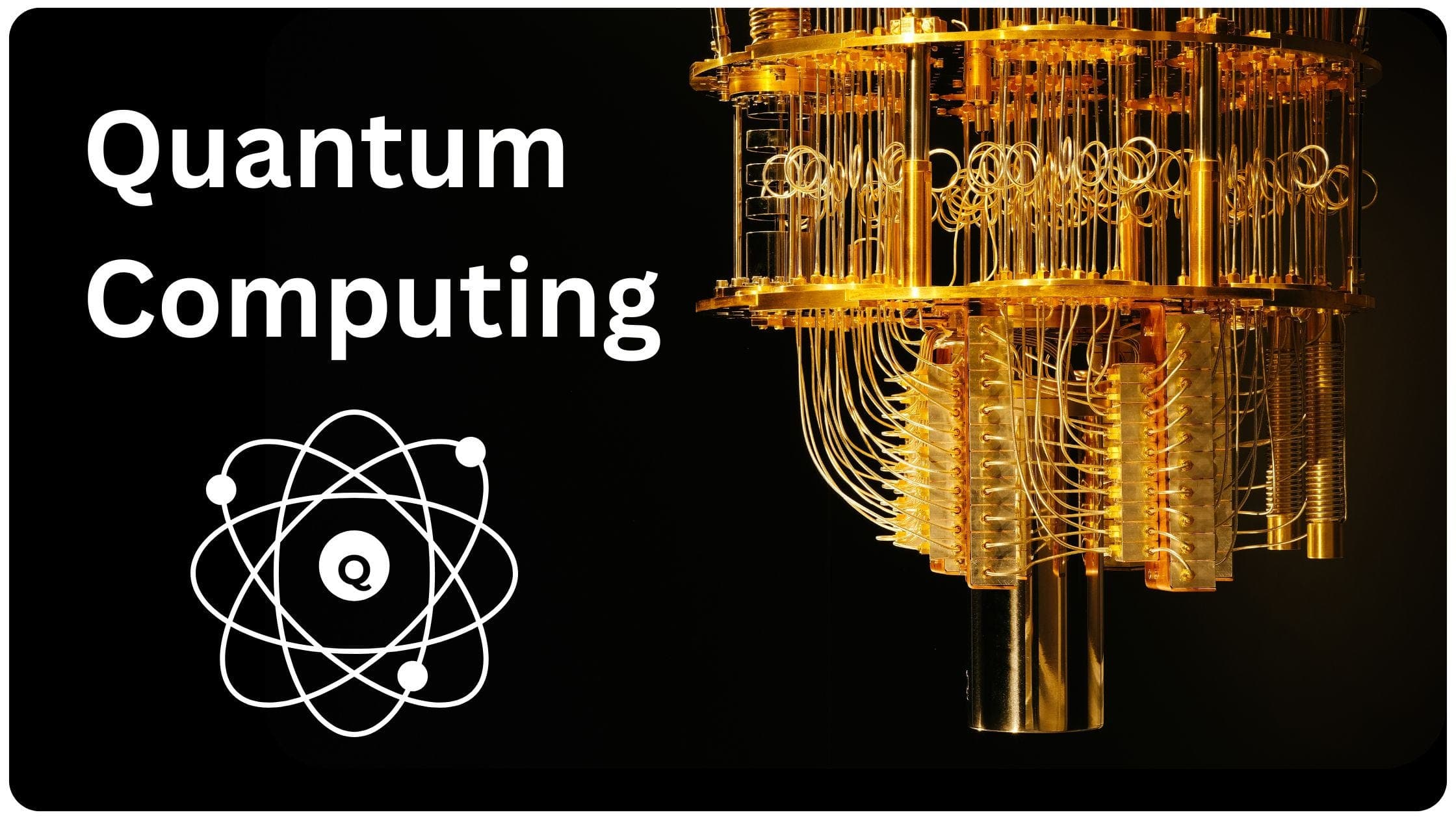
Quantum Computing
Quantum Computing: The Complete Guide #part2
Quantum computing is a revolutionary computing paradigm that harnesses the principles of quantum mechanics to solve problems beyond the reach of today's classical computers. In this first part, you'll discover its origins, scientific foundations, history, evolution, and why it is considered one of the most transformative technologies of the 21st century.
In Part 1, we explored the history, evolution, and fundamental idea behind quantum computing. In this section, we'll dive deeper into the science that powers quantum computers, explain how they process information, and examine the hardware that makes them possible.
Table of Contents (Part 2)
- Why Quantum Mechanics Is Essential
- Understanding Classical Bits
- What Is a Qubit?
- Superposition
- Quantum Entanglement
- Quantum Interference
- Quantum Measurement
- The Bloch Sphere
- Quantum Gates
- Quantum Circuits
- Quantum Algorithms
- Quantum Error Correction
- Quantum Decoherence
- Quantum Hardware Technologies
- Current State of Quantum Hardware
- Key Takeaways
Why Quantum Mechanics Is Essential
To understand quantum computing, you first need to understand quantum mechanics—the branch of physics that describes nature at the smallest scales, such as atoms, electrons, photons, and other subatomic particles.
Unlike classical physics, which explains the behavior of everyday objects, quantum mechanics introduces phenomena that often seem counterintuitive. These include particles existing in probabilistic states, becoming correlated over long distances, and behaving differently when measured.
Quantum computers are built to exploit these physical properties rather than avoid them.
Scientific Fact
Quantum mechanics is one of the most experimentally verified theories in science. Technologies such as lasers, semiconductors, MRI machines, and atomic clocks all rely on quantum principles.
Understanding Classical Bits
Every modern computer—from smartphones and laptops to supercomputers—stores information using bits.
A bit can only have one of two values:
- 0
- 1
These values are represented physically by electronic states, such as low/high voltage or off/on transistors.
For example:
| Binary | Decimal |
|---|---|
| 0 | 0 |
| 1 | 1 |
| 10 | 2 |
| 11 | 3 |
| 100 | 4 |
Billions of transistors switching between 0 and 1 allow classical computers to perform calculations.
However, every bit is always in one definite state at any given moment.
What Is a Qubit?
The qubit (quantum bit) is the fundamental unit of information in a quantum computer.
Like a classical bit, a qubit can represent 0 and 1.
But unlike a classical bit, it can also exist in a superposition of both states.
Mathematically, a qubit is described as:
where:
- α and β are complex probability amplitudes.
- Their squared magnitudes determine the probabilities of measuring 0 or 1.
- They satisfy the normalization condition:
This means a qubit does not simultaneously store two classical values. Instead, it occupies a quantum state that evolves according to the laws of quantum mechanics.
A Helpful Analogy
Imagine a spinning coin.
- A coin lying flat shows heads or tails.
- While spinning, it is not simply one or the other from a measurement perspective.
A qubit is not exactly like a spinning coin, but the analogy helps illustrate that its state is not fixed in the same way as a classical bit.
The true behavior is governed by quantum probability amplitudes rather than everyday motion.
Superposition
Superposition is one of the defining features of quantum computing.
A qubit can exist in a combination of the basis states |0⟩ and |1⟩ until it is measured.
This allows quantum algorithms to manipulate many possible computational paths simultaneously within the quantum state.
Why It Matters
Suppose you have:
- 1 classical bit → 2 possible values (stored one at a time)
- 1 qubit → a superposition of 0 and 1
- 2 qubits → a state over 4 basis combinations
- 3 qubits → 8 basis combinations
- n qubits → basis states
This exponential growth in the size of the state space is one reason quantum computers can be powerful for certain problems.
Important Note
A quantum computer does not automatically obtain every answer in one step. The challenge is designing algorithms that use interference to amplify the probability of correct answers while suppressing incorrect ones.
Quantum Entanglement
Perhaps the most fascinating phenomenon in quantum mechanics is entanglement.
When two or more qubits become entangled, their quantum states become correlated in ways that cannot be described independently.
For example, measuring one qubit can instantly determine the correlated outcome of another, even if they are physically separated.
This does not allow faster-than-light communication. Instead, it reflects the mathematical structure of quantum states.
Entanglement enables quantum computers to coordinate many qubits efficiently during computation.
Why Entanglement Matters
Without entanglement:
- Quantum algorithms lose much of their computational advantage.
- Complex quantum states cannot be created.
- Large-scale quantum computations become impossible.
Many of the most powerful quantum algorithms rely heavily on entangled states.
Quantum Interference
Another essential concept is quantum interference.
Quantum states behave like waves.
Just as water waves can:
- Reinforce each other (constructive interference)
- Cancel each other (destructive interference)
Quantum probability amplitudes can interfere in similar ways.
Quantum algorithms are carefully designed so that:
- Correct computational paths reinforce one another.
- Incorrect paths cancel out.
This is how quantum computers increase the likelihood of obtaining the desired result upon measurement.
Quantum Measurement
Measurement plays a unique role in quantum computing.
Before measurement, a qubit is described by its quantum state.
After measurement, the qubit yields a definite classical outcome—typically 0 or 1—with probabilities determined by its amplitudes.
For example:
- Probability of measuring 0 = 70%
- Probability of measuring 1 = 30%
Repeated measurements of identically prepared qubits produce outcomes that match these probabilities statistically.
Measurement also changes the quantum state, a phenomenon often described as state collapse in introductory treatments.
Expert Insight
Because measurement converts quantum information into classical information, quantum algorithms are designed to delay measurement until the computation has been completed.
The Bloch Sphere
A single qubit can be visualized using the Bloch Sphere.
Imagine a sphere where:
- North Pole → |0⟩
- South Pole → |1⟩
- Every other point represents a valid superposition state
This visualization helps researchers understand how quantum gates rotate qubit states during computation.
Unlike a classical bit, which has only two possible states, a qubit can occupy infinitely many points on the Bloch Sphere.
Quantum Gates
Classical computers use logic gates such as:
- AND
- OR
- NOT
- NAND
- XOR
Quantum computers use quantum gates, which manipulate qubit states through reversible operations.
Common quantum gates include:
| Gate | Purpose |
|---|---|
| X Gate | Flips a qubit (similar to NOT) |
| H (Hadamard) Gate | Creates superposition |
| Z Gate | Changes the phase of a qubit |
| Y Gate | Rotates the qubit around the Y-axis |
| S Gate | Applies a phase shift |
| T Gate | Applies a smaller phase shift |
| CNOT Gate | Entangles two qubits |
| SWAP Gate | Exchanges the states of two qubits |
Unlike classical logic gates, quantum gates are represented by unitary matrices, ensuring that quantum evolution preserves information until measurement.
Quantum Circuits
A quantum circuit is a sequence of quantum gates applied to qubits.
The typical workflow is:
- Initialize qubits.
- Apply quantum gates.
- Create superposition.
- Generate entanglement.
- Perform interference.
- Measure the qubits to obtain classical results.
Quantum circuits are the quantum equivalent of programs executed by classical computers.
Quantum Algorithms
A quantum computer's power comes not only from its hardware but also from the algorithms it runs.
Some of the most influential algorithms include:
Shor's Algorithm
Developed by Peter Shor in 1994, this algorithm can factor large integers much more efficiently than the best-known classical methods.
Potential impact:
- Challenges widely used public-key cryptographic systems such as RSA.
- Motivates the development of post-quantum cryptography.
Grover's Algorithm
Introduced by Lov Grover in 1996, this algorithm provides a quadratic speedup for searching unsorted datasets.
Possible applications include:
- Database search
- Optimization
- Cryptanalysis
- Pattern matching
Quantum Simulation
Originally envisioned by Richard Feynman, quantum simulation aims to model molecules, materials, and quantum systems more naturally than classical computers.
Potential applications include:
- Drug discovery
- Battery research
- Superconducting materials
- Catalysts for clean energy
Quantum Error Correction
Quantum systems are extremely sensitive to noise.
Small disturbances from the environment can introduce errors that quickly accumulate.
Unlike classical bits, qubits cannot simply be copied due to the no-cloning theorem, which states that unknown quantum states cannot be perfectly duplicated.
Instead, quantum error correction spreads logical information across multiple physical qubits, allowing certain errors to be detected and corrected without directly measuring the encoded information.
This is a major area of ongoing research and is essential for building large-scale, reliable quantum computers.
Quantum Decoherence
One of the biggest challenges in quantum computing is decoherence.
Decoherence occurs when qubits interact with their environment and gradually lose their quantum properties.
Sources of decoherence include:
- Heat
- Electromagnetic radiation
- Vibrations
- Material imperfections
- Cosmic rays
- Manufacturing defects
When decoherence occurs:
- Superposition degrades.
- Entanglement weakens.
- Computation becomes unreliable.
Modern quantum hardware is designed to minimize these effects through careful engineering, shielding, and error mitigation techniques.
Quantum Hardware Technologies
There is no single way to build a quantum computer. Different research groups pursue different hardware platforms, each with its own strengths and challenges.
| Technology | Advantages | Challenges |
|---|---|---|
| Superconducting Qubits | Fast gate operations, mature fabrication | Require cryogenic temperatures and are sensitive to noise |
| Trapped Ions | High-fidelity operations, long coherence times | Slower gate speeds and complex laser control |
| Neutral Atoms | Good scalability potential | Precision control remains challenging |
| Photonic Qubits | Operate at room temperature and integrate with communication systems | Two-qubit operations are technically demanding |
| Silicon Spin Qubits | Compatible with existing semiconductor manufacturing | Still at an early stage of development |
No platform has yet emerged as the definitive winner, and research continues across all of them.
Current State of Quantum Hardware
Today's quantum computers are often described as Noisy Intermediate-Scale Quantum (NISQ) devices.
Characteristics include:
- Tens to a few thousand physical qubits (depending on the platform and definition).
- Imperfect gate operations.
- Limited coherence times.
- No full fault tolerance.
- Useful primarily for research, education, and exploratory applications.
Researchers worldwide are working toward fault-tolerant quantum computers, which will require advances in hardware, error correction, and software.
Key Takeaways (Part 2)
- Qubits are the building blocks of quantum computers.
- Superposition allows qubits to occupy combinations of states.
- Entanglement creates strong correlations between qubits.
- Interference helps quantum algorithms amplify correct solutions.
- Measurement converts quantum information into classical outcomes.
- Quantum gates manipulate qubit states through reversible operations.
- Quantum circuits form the basis of quantum programs.
- Quantum algorithms such as Shor's and Grover's demonstrate potential computational advantages for specific tasks.
- Error correction and decoherence remain central challenges.
- Multiple hardware technologies are competing to build scalable, fault-tolerant quantum computers.
Quantum Computing: The Complete Guide (Part 2)
In Part 1, we explored the history, evolution, and fundamental idea behind quantum computing. In this section, we'll dive deeper into the science that powers quantum computers, explain how they process information, and examine the hardware that makes them possible.
Table of Contents (Part 2)
- Why Quantum Mechanics Is Essential
- Understanding Classical Bits
- What Is a Qubit?
- Superposition
- Quantum Entanglement
- Quantum Interference
- Quantum Measurement
- The Bloch Sphere
- Quantum Gates
- Quantum Circuits
- Quantum Algorithms
- Quantum Error Correction
- Quantum Decoherence
- Quantum Hardware Technologies
- Current State of Quantum Hardware
- Key Takeaways
Why Quantum Mechanics Is Essential
To understand quantum computing, you first need to understand quantum mechanics—the branch of physics that describes nature at the smallest scales, such as atoms, electrons, photons, and other subatomic particles.
Unlike classical physics, which explains the behavior of everyday objects, quantum mechanics introduces phenomena that often seem counterintuitive. These include particles existing in probabilistic states, becoming correlated over long distances, and behaving differently when measured.
Quantum computers are built to exploit these physical properties rather than avoid them.
Scientific Fact
Quantum mechanics is one of the most experimentally verified theories in science. Technologies such as lasers, semiconductors, MRI machines, and atomic clocks all rely on quantum principles.
Understanding Classical Bits
Every modern computer—from smartphones and laptops to supercomputers—stores information using bits.
A bit can only have one of two values:
- 0
- 1
These values are represented physically by electronic states, such as low/high voltage or off/on transistors.
For example:
| Binary | Decimal |
|---|---|
| 0 | 0 |
| 1 | 1 |
| 10 | 2 |
| 11 | 3 |
| 100 | 4 |
Billions of transistors switching between 0 and 1 allow classical computers to perform calculations.
However, every bit is always in one definite state at any given moment.
What Is a Qubit?
The qubit (quantum bit) is the fundamental unit of information in a quantum computer.
Like a classical bit, a qubit can represent 0 and 1.
But unlike a classical bit, it can also exist in a superposition of both states.
Mathematically, a qubit is described as:
where:
- α and β are complex probability amplitudes.
- Their squared magnitudes determine the probabilities of measuring 0 or 1.
- They satisfy the normalization condition:
This means a qubit does not simultaneously store two classical values. Instead, it occupies a quantum state that evolves according to the laws of quantum mechanics.
A Helpful Analogy
Imagine a spinning coin.
- A coin lying flat shows heads or tails.
- While spinning, it is not simply one or the other from a measurement perspective.
A qubit is not exactly like a spinning coin, but the analogy helps illustrate that its state is not fixed in the same way as a classical bit.
The true behavior is governed by quantum probability amplitudes rather than everyday motion.
Superposition
Superposition is one of the defining features of quantum computing.
A qubit can exist in a combination of the basis states |0⟩ and |1⟩ until it is measured.
This allows quantum algorithms to manipulate many possible computational paths simultaneously within the quantum state.
Why It Matters
Suppose you have:
- 1 classical bit → 2 possible values (stored one at a time)
- 1 qubit → a superposition of 0 and 1
- 2 qubits → a state over 4 basis combinations
- 3 qubits → 8 basis combinations
- n qubits → basis states
This exponential growth in the size of the state space is one reason quantum computers can be powerful for certain problems.
Important Note
A quantum computer does not automatically obtain every answer in one step. The challenge is designing algorithms that use interference to amplify the probability of correct answers while suppressing incorrect ones.
Quantum Entanglement
Perhaps the most fascinating phenomenon in quantum mechanics is entanglement.
When two or more qubits become entangled, their quantum states become correlated in ways that cannot be described independently.
For example, measuring one qubit can instantly determine the correlated outcome of another, even if they are physically separated.
This does not allow faster-than-light communication. Instead, it reflects the mathematical structure of quantum states.
Entanglement enables quantum computers to coordinate many qubits efficiently during computation.
Why Entanglement Matters
Without entanglement:
- Quantum algorithms lose much of their computational advantage.
- Complex quantum states cannot be created.
- Large-scale quantum computations become impossible.
Many of the most powerful quantum algorithms rely heavily on entangled states.
Quantum Interference
Another essential concept is quantum interference.
Quantum states behave like waves.
Just as water waves can:
- Reinforce each other (constructive interference)
- Cancel each other (destructive interference)
Quantum probability amplitudes can interfere in similar ways.
Quantum algorithms are carefully designed so that:
- Correct computational paths reinforce one another.
- Incorrect paths cancel out.
This is how quantum computers increase the likelihood of obtaining the desired result upon measurement.
Quantum Measurement
Measurement plays a unique role in quantum computing.
Before measurement, a qubit is described by its quantum state.
After measurement, the qubit yields a definite classical outcome—typically 0 or 1—with probabilities determined by its amplitudes.
For example:
- Probability of measuring 0 = 70%
- Probability of measuring 1 = 30%
Repeated measurements of identically prepared qubits produce outcomes that match these probabilities statistically.
Measurement also changes the quantum state, a phenomenon often described as state collapse in introductory treatments.
Expert Insight
Because measurement converts quantum information into classical information, quantum algorithms are designed to delay measurement until the computation has been completed.
The Bloch Sphere
A single qubit can be visualized using the Bloch Sphere.
Imagine a sphere where:
- North Pole → |0⟩
- South Pole → |1⟩
- Every other point represents a valid superposition state
This visualization helps researchers understand how quantum gates rotate qubit states during computation.
Unlike a classical bit, which has only two possible states, a qubit can occupy infinitely many points on the Bloch Sphere.
Quantum Gates
Classical computers use logic gates such as:
- AND
- OR
- NOT
- NAND
- XOR
Quantum computers use quantum gates, which manipulate qubit states through reversible operations.
Common quantum gates include:
| Gate | Purpose |
|---|---|
| X Gate | Flips a qubit (similar to NOT) |
| H (Hadamard) Gate | Creates superposition |
| Z Gate | Changes the phase of a qubit |
| Y Gate | Rotates the qubit around the Y-axis |
| S Gate | Applies a phase shift |
| T Gate | Applies a smaller phase shift |
| CNOT Gate | Entangles two qubits |
| SWAP Gate | Exchanges the states of two qubits |
Unlike classical logic gates, quantum gates are represented by unitary matrices, ensuring that quantum evolution preserves information until measurement.
Quantum Circuits
A quantum circuit is a sequence of quantum gates applied to qubits.
The typical workflow is:
- Initialize qubits.
- Apply quantum gates.
- Create superposition.
- Generate entanglement.
- Perform interference.
- Measure the qubits to obtain classical results.
Quantum circuits are the quantum equivalent of programs executed by classical computers.
Quantum Algorithms
A quantum computer's power comes not only from its hardware but also from the algorithms it runs.
Some of the most influential algorithms include:
Shor's Algorithm
Developed by Peter Shor in 1994, this algorithm can factor large integers much more efficiently than the best-known classical methods.
Potential impact:
- Challenges widely used public-key cryptographic systems such as RSA.
- Motivates the development of post-quantum cryptography.
Grover's Algorithm
Introduced by Lov Grover in 1996, this algorithm provides a quadratic speedup for searching unsorted datasets.
Possible applications include:
- Database search
- Optimization
- Cryptanalysis
- Pattern matching
Quantum Simulation
Originally envisioned by Richard Feynman, quantum simulation aims to model molecules, materials, and quantum systems more naturally than classical computers.
Potential applications include:
- Drug discovery
- Battery research
- Superconducting materials
- Catalysts for clean energy
Quantum Error Correction
Quantum systems are extremely sensitive to noise.
Small disturbances from the environment can introduce errors that quickly accumulate.
Unlike classical bits, qubits cannot simply be copied due to the no-cloning theorem, which states that unknown quantum states cannot be perfectly duplicated.
Instead, quantum error correction spreads logical information across multiple physical qubits, allowing certain errors to be detected and corrected without directly measuring the encoded information.
This is a major area of ongoing research and is essential for building large-scale, reliable quantum computers.
Quantum Decoherence
One of the biggest challenges in quantum computing is decoherence.
Decoherence occurs when qubits interact with their environment and gradually lose their quantum properties.
Sources of decoherence include:
- Heat
- Electromagnetic radiation
- Vibrations
- Material imperfections
- Cosmic rays
- Manufacturing defects
When decoherence occurs:
- Superposition degrades.
- Entanglement weakens.
- Computation becomes unreliable.
Modern quantum hardware is designed to minimize these effects through careful engineering, shielding, and error mitigation techniques.
Quantum Hardware Technologies
There is no single way to build a quantum computer. Different research groups pursue different hardware platforms, each with its own strengths and challenges.
| Technology | Advantages | Challenges |
|---|---|---|
| Superconducting Qubits | Fast gate operations, mature fabrication | Require cryogenic temperatures and are sensitive to noise |
| Trapped Ions | High-fidelity operations, long coherence times | Slower gate speeds and complex laser control |
| Neutral Atoms | Good scalability potential | Precision control remains challenging |
| Photonic Qubits | Operate at room temperature and integrate with communication systems | Two-qubit operations are technically demanding |
| Silicon Spin Qubits | Compatible with existing semiconductor manufacturing | Still at an early stage of development |
No platform has yet emerged as the definitive winner, and research continues across all of them.
Current State of Quantum Hardware
Today's quantum computers are often described as Noisy Intermediate-Scale Quantum (NISQ) devices.
Characteristics include:
- Tens to a few thousand physical qubits (depending on the platform and definition).
- Imperfect gate operations.
- Limited coherence times.
- No full fault tolerance.
- Useful primarily for research, education, and exploratory applications.
Researchers worldwide are working toward fault-tolerant quantum computers, which will require advances in hardware, error correction, and software.
Key Takeaways (Part 2)
- Qubits are the building blocks of quantum computers.
- Superposition allows qubits to occupy combinations of states.
- Entanglement creates strong correlations between qubits.
- Interference helps quantum algorithms amplify correct solutions.
- Measurement converts quantum information into classical outcomes.
- Quantum gates manipulate qubit states through reversible operations.
- Quantum circuits form the basis of quantum programs.
- Quantum algorithms such as Shor's and Grover's demonstrate potential computational advantages for specific tasks.
- Error correction and decoherence remain central challenges.
- Multiple hardware technologies are competing to build scalable, fault-tolerant quantum computers.
Write your article here...
About the Author
Aslam Hossain is the founder and editor of Vishtech Blog, creating accessible technology content about AI, software, startups, robotics, cybersecurity, and future innovations.
Comments
Article text preview: In Part 1, we explored the history, evolution, and fundamental idea behind quantum computing. In this section, we'll dive deeper into the science that