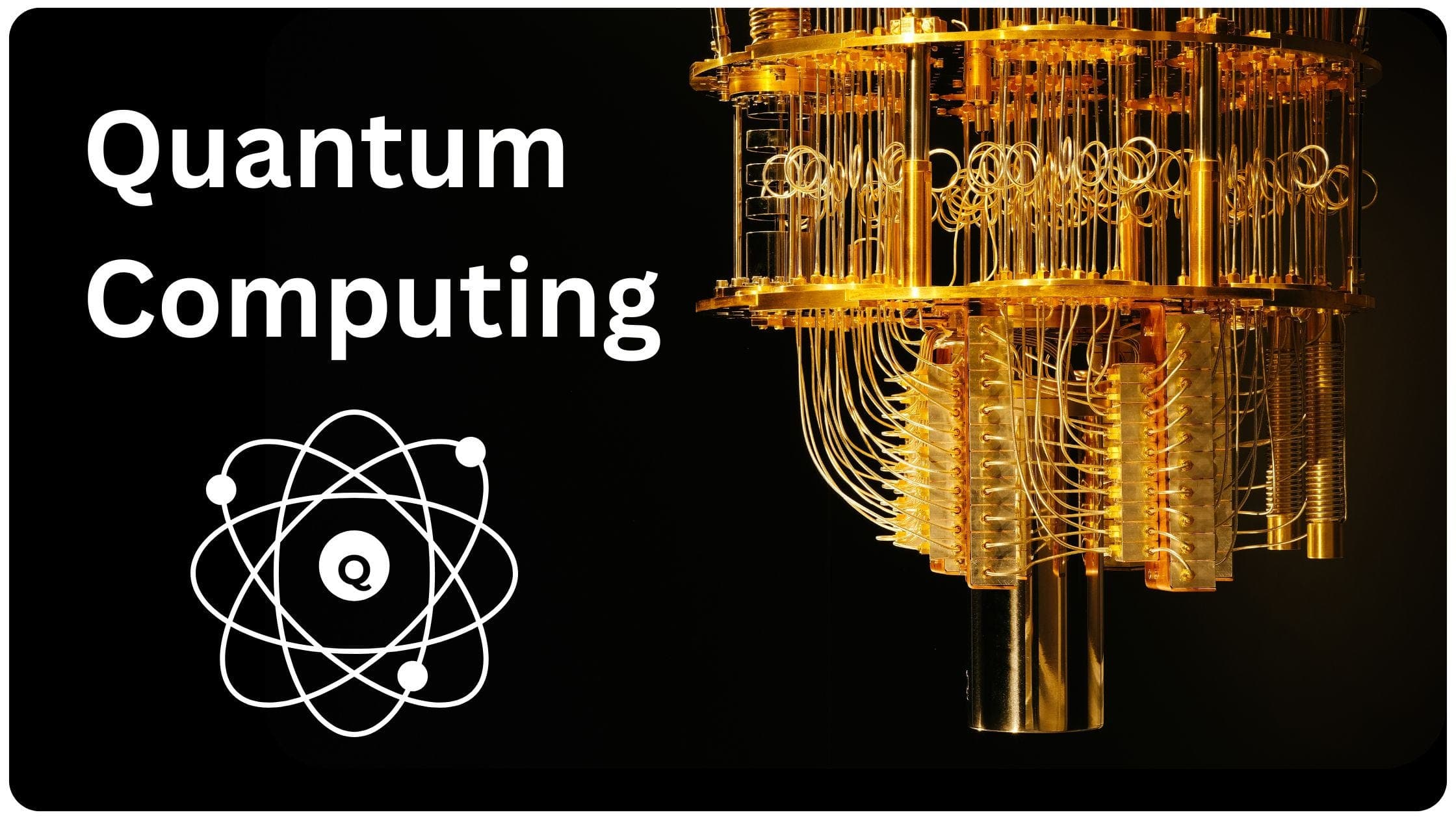
Quantum Computing
Quantum Computing: The Complete Guide #part5
Quantum computing is a revolutionary computing paradigm that harnesses the principles of quantum mechanics to solve problems beyond the reach of today's classical computers. In this first part, you'll discover its origins, scientific foundations, history, evolution, and why it is considered one of the most transformative technologies of the 21st century.
This final part brings together everything discussed in the previous sections, looking ahead to the future of quantum computing while separating scientific reality from speculation. You'll also find practical guidance, SEO-ready content, FAQs, and publishing assets to make this article website-ready.
Table of Contents (Part 5)
- The Future of Quantum Computing
- Scientific Reality vs Speculation
- Quantum Computing Timeline
- Pros & Cons
- Common Myths
- Best Practices
- Learning Roadmap
- Key Takeaways
- People Also Ask
- Frequently Asked Questions
- FAQ Schema
- Image & Infographic Suggestions
- Suggested Internal Links
- Suggested External References
- Final Conclusion
The Future of Quantum Computing
Predicting the future of any emerging technology is difficult, especially one as technically demanding as quantum computing. While the field has made remarkable progress, its long-term success depends on solving fundamental engineering challenges.
Rather than making bold claims, it's helpful to distinguish between what is already known, what researchers are actively working on, and what remains speculative.
Established Scientific Facts
The following statements are supported by current scientific evidence:
- Quantum mechanics accurately describes microscopic physical systems.
- Quantum computers already exist and can execute quantum algorithms.
- Quantum processors have demonstrated advantages for certain specialized benchmark tasks.
- Quantum computing is fundamentally different from classical computing.
- Large-scale fault-tolerant quantum computers have not yet been achieved.
- Classical computers will continue to be essential even as quantum technology advances.
Current Research
Researchers around the world are actively pursuing:
- Fault-tolerant quantum computers
- Better quantum error correction
- Longer qubit coherence times
- Scalable quantum hardware
- Quantum networking
- Hybrid quantum-classical algorithms
- Improved quantum software development tools
- Quantum-enhanced optimization and simulation
These areas are expected to define the next decade of quantum computing research.
Expert Predictions
Many experts anticipate the following developments over the coming years:
- Increased use of hybrid quantum-classical computing.
- Wider adoption of cloud-based quantum platforms.
- More practical applications in chemistry and materials science.
- Continued migration toward post-quantum cryptography.
- Growth in the quantum software ecosystem.
- Expansion of university programs and workforce training.
These predictions are informed by current trends but are not guaranteed outcomes.
Speculative Possibilities
Some ideas frequently discussed remain speculative and should not be presented as established facts:
- A fully operational global quantum internet.
- Consumer quantum computers for everyday home use.
- Quantum computers replacing laptops or smartphones.
- Artificial General Intelligence (AGI) powered primarily by quantum computing.
- Instant solutions to every computational problem.
While these possibilities are interesting, they depend on breakthroughs that have not yet been demonstrated.
Important Note
Scientific progress often takes longer than public expectations. Responsible reporting should clearly distinguish between evidence-based research and long-term speculation.
Quantum Computing Timeline
| Year | Milestone |
|---|---|
| 1900 | Max Planck introduces quantum theory. |
| 1905 | Albert Einstein explains the photoelectric effect. |
| 1925–1927 | Foundations of modern quantum mechanics are established. |
| 1981 | Richard Feynman proposes quantum simulation. |
| 1985 | David Deutsch describes the universal quantum computer. |
| 1994 | Peter Shor introduces Shor's algorithm. |
| 1996 | Lov Grover introduces Grover's algorithm. |
| 2000s | Experimental quantum processors begin to emerge. |
| 2010s | Cloud-accessible quantum computing becomes available. |
| 2019 | Google reports a specialized quantum advantage demonstration. |
| 2020s | Rapid progress in hardware, software, and error correction research. |
| Future | Fault-tolerant quantum computing (research goal). |
Pros & Cons
| Pros | Cons |
|---|---|
| Can efficiently solve certain specialized problems | Not faster for all computing tasks |
| Powerful for quantum simulation | Current hardware is noisy |
| May improve optimization problems | Error correction remains difficult |
| Advances chemistry and materials science | Very expensive infrastructure |
| Encourages scientific innovation | Limited practical applications today |
| Supports new cryptographic research | Requires highly specialized expertise |
Common Myths About Quantum Computing
Myth 1: Quantum Computers Will Replace Classical Computers
Reality:
Quantum computers are designed for specialized tasks. Classical computers will remain essential for general-purpose computing.
Myth 2: Quantum Computers Are Instantly Faster at Everything
Reality:
Quantum advantage exists only for certain algorithms and problem classes.
Myth 3: Quantum Computing Breaks All Encryption Today
Reality:
Current quantum hardware cannot break modern internet encryption at scale. This is a future concern that has motivated the development of post-quantum cryptography.
Myth 4: Quantum Computers Perform Infinite Calculations Simultaneously
Reality:
Quantum algorithms rely on superposition, interference, and measurement. They do not simply "try every answer at once."
Myth 5: Quantum Computing Is Just Better Artificial Intelligence
Reality:
Quantum computing and AI are separate fields. While they may complement one another, one does not replace the other.
Best Practices for Organizations
Companies considering quantum technologies should take a measured approach.
1. Focus on Education
Develop internal knowledge before investing heavily in hardware or applications.
2. Explore Hybrid Computing
Use quantum processors alongside classical systems where appropriate.
3. Prepare for Post-Quantum Cryptography
Assess cryptographic systems and develop migration plans to quantum-resistant standards.
4. Start with Pilot Projects
Experiment with small-scale research projects to understand potential value.
5. Collaborate with Experts
Partner with universities, research institutions, and technology providers.
Learning Roadmap for Beginners
If you're new to quantum computing, the following progression can help you build a strong foundation:
- Learn basic linear algebra.
- Understand introductory quantum mechanics.
- Study probability and complex numbers.
- Learn Python programming.
- Explore quantum programming frameworks such as Qiskit or Cirq.
- Build simple quantum circuits using cloud-based simulators.
- Study quantum algorithms and error correction.
- Follow current research through academic journals and conferences.
Key Takeaways
Quantum computing is not a faster version of today's computers—it is a fundamentally different model of computation.
- It is based on the principles of quantum mechanics.
- Qubits enable computation using superposition and entanglement.
- Quantum computers excel at specific classes of problems rather than all tasks.
- Major applications include chemistry, optimization, cryptography, and scientific simulation.
- Current hardware remains limited by noise and error rates.
- Governments, universities, startups, and major technology companies are investing heavily in research.
- Hybrid quantum-classical systems are likely to dominate the near future.
- Responsible communication requires distinguishing proven science from speculation.
People Also Ask (PAA)
What is quantum computing in simple words?
Quantum computing is a type of computing that uses the principles of quantum mechanics to process information using qubits instead of classical bits.
How is a quantum computer different from a classical computer?
Classical computers process information using bits (0 or 1), while quantum computers use qubits, which can exist in superpositions and become entangled, enabling different computational strategies.
Can quantum computers replace normal computers?
No. Quantum computers are expected to complement classical computers rather than replace them.
Why is quantum computing important?
It has the potential to accelerate scientific research, optimize complex systems, improve materials discovery, and contribute to advances in cryptography.
Who is leading in quantum computing?
Many organizations contribute to the field, including technology companies, startups, universities, and government research laboratories. Progress depends on both hardware and software innovations.
Is quantum computing available today?
Yes. Experimental quantum computers are available through cloud platforms, although they remain limited in capability compared to the long-term goals of fault-tolerant quantum computing.
Frequently Asked Questions (FAQ)
Is quantum computing difficult to learn?
It combines concepts from physics, mathematics, and computer science, but beginners can start with introductory resources and gradually build their understanding.
Does quantum computing use artificial intelligence?
No. They are separate technologies, although researchers are exploring ways to combine them.
Can quantum computers solve every problem?
No. They provide advantages only for specific categories of problems.
Are quantum computers commercially available?
Yes, but primarily through cloud access for research, education, and experimentation.
Why do quantum computers need extremely low temperatures?
Some hardware platforms, such as superconducting qubits, require cryogenic temperatures to reduce thermal noise and maintain quantum coherence. Other platforms have different operating requirements.
Will quantum computing create new jobs?
Yes. Growth in the field is expected to increase demand for physicists, engineers, software developers, mathematicians, cybersecurity specialists, and quantum algorithm researchers.
FAQ Schema (JSON-LD Ready)
{
  "@context": "https://schema.org",
  "@type": "FAQPage",
  "mainEntity": [
    {
      "@type": "Question",
      "name": "What is quantum computing?",
      "acceptedAnswer": {
        "@type": "Answer",
        "text": "Quantum computing is a computational approach that uses quantum mechanical principles such as superposition and entanglement to process information."
      }
    },
    {
      "@type": "Question",
      "name": "Can quantum computers replace classical computers?",
      "acceptedAnswer": {
        "@type": "Answer",
        "text": "No. Quantum computers are designed to complement classical computers by solving specialized computational problems."
      }
    },
    {
      "@type": "Question",
      "name": "What are qubits?",
      "acceptedAnswer": {
        "@type": "Answer",
        "text": "Qubits are the fundamental units of information in a quantum computer and can exist in superpositions of states."
      }
    }
  ]
}
Image Placement Suggestions
| Section | Suggested Image |
|---|---|
| Introduction | Artistic illustration of a quantum processor |
| History | Timeline infographic of quantum computing milestones |
| How It Works | Diagram of a qubit on the Bloch Sphere |
| Superposition | Visual comparison of classical bits and qubits |
| Entanglement | Simplified illustration of correlated qubits |
| Quantum Gates | Quantum circuit diagram |
| Applications | Industry icons surrounding a quantum computer |
| Hardware | Comparison of superconducting, trapped-ion, and photonic systems |
| Future | Futuristic illustration of quantum research laboratories |
Infographic Suggestions
Create visual assets covering:
- Classical Computing vs. Quantum Computing
- Anatomy of a Qubit
- Quantum Computing Timeline
- Major Industry Applications
- Quantum Hardware Technologies
- The Quantum Computing Ecosystem
- Current Challenges and Future Goals
- Learning Roadmap for Beginners
Suggested Internal Links
Link this article to related content on your website, such as:
- Artificial Intelligence Explained
- Cloud Computing Guide
- Cybersecurity Fundamentals
- Machine Learning Basics
- Blockchain Technology
- Internet of Things (IoT)
- High-Performance Computing
- Edge Computing
- Data Science for Beginners
Suggested External References
To strengthen the article's credibility, reference authoritative organizations and educational resources, including:
- IBM Quantum
- Google Quantum AI
- Microsoft Quantum
- National Institute of Standards and Technology (NIST)
- MIT Center for Quantum Engineering
- CERN (for foundational physics context)
- Nature (peer-reviewed research)
- Science (peer-reviewed research)
- IEEE Xplore Digital Library
- arXiv (preprints, used with appropriate caution)
Final Conclusion
Quantum computing represents one of the most ambitious scientific and engineering endeavors of the 21st century. Unlike previous advances that primarily increased the speed or efficiency of classical computers, quantum computing introduces an entirely new way of processing information—one rooted in the fundamental laws of quantum mechanics.
Although today's quantum processors remain in the Noisy Intermediate-Scale Quantum (NISQ) era, they have already demonstrated the feasibility of quantum computation and inspired a rapidly growing ecosystem of researchers, engineers, startups, governments, and global technology companies. Progress is no longer measured solely by the number of qubits but also by improvements in coherence, gate fidelity, error correction, and scalable architectures.
The greatest near-term promise lies in domains where quantum mechanics naturally governs the underlying problems, such as molecular simulation, materials discovery, optimization, and certain cryptographic and scientific computations. At the same time, many widely publicized claims—such as replacing personal computers or instantly solving every computational challenge—remain speculative and should be treated with caution.
The future of quantum computing is likely to be collaborative rather than disruptive. Classical computers will continue to perform everyday computing tasks, while quantum processors are expected to serve as specialized accelerators for problems that are exceptionally difficult for conventional systems. Hybrid quantum-classical workflows are therefore expected to play a central role in the technology's evolution.
As research continues, responsible communication is essential. Distinguishing established scientific facts, ongoing research, expert predictions, and speculative possibilities helps build public trust and supports informed decision-making. Whether quantum computing ultimately transforms medicine, energy, cybersecurity, materials science, or other fields will depend not only on scientific breakthroughs but also on sustained investment, international collaboration, and careful engineering.
For students, researchers, businesses, and technology enthusiasts, now is an excellent time to begin learning about quantum computing. While practical, large-scale quantum computers may still be years away, the knowledge and skills developed today will help shape one of the most exciting frontiers in modern science and technology.Write your article here...
About the Author
Aslam Hossain is the founder and editor of Vishtech Blog, creating accessible technology content about AI, software, startups, robotics, cybersecurity, and future innovations.
Comments
Article text preview: This final part brings together everything discussed in the previous sections, looking ahead to the future of quantum computing while separating scien